
From Peer to Peer Learning: How YPSA Is Making SRHR Conversations Easier in Chattogram
For many adolescents, asking a question about menstruation, puberty, relationships or reproductive health can feel harder than facing an exam. The information may exist, but reaching the right person is often the real challenge.
That is where a peer educator can make a difference.
In Chattogram, Young Power in Social Action (YPSA) is putting young people at the centre of sexual and reproductive health and rights (SRHR) education. Under its Health System Resiliency for Improved SRHR in Bangladesh project, implemented with BAPSA and MAMATA and supported by Global Affairs Canada and HealthBridge Foundation, YPSA is training young people to become trusted sources of SRHR information within their own communities.
The model is simple. Instead of expecting every adolescent to approach a doctor, teacher or programme officer with a sensitive question, trained young people can start the conversation where adolescents are most comfortable: among their peers.
According to the programme information shared by YPSA, a network of 150 trained peer educators is expected to conduct around 1,200 sessions each month, with an ambition to reach more than 100,000 adolescents.
This approach is particularly relevant in Bangladesh, where access to accurate and age-appropriate sexuality education remains a challenge. A 2025 UNFPA review of Bangladesh’s secondary education curriculum says life-skills education, also referred to as comprehensive sexuality education, can help young people make informed decisions about health, relationships, safety and their future. It also points to child marriage, early pregnancy, gender-based violence and limited access to accurate information as major adolescent challenges.
The policy direction is not new. Bangladesh’s National Strategy for Adolescent Health 2017-2030 called for age-appropriate CSE to be strengthened across academic and training institutions. But having CSE in policy is different from ensuring that every adolescent receives clear, practical and trusted information.
This is where Chattogram offers an important lesson.
YPSA has been using peer education in the region for years. Its earlier programmes included peer educators, adolescent clubs and school-based SRH activities. In one initiative, YPSA reported that school-based interventions improved adolescents’ SRH knowledge, practices, skills and attitudes.
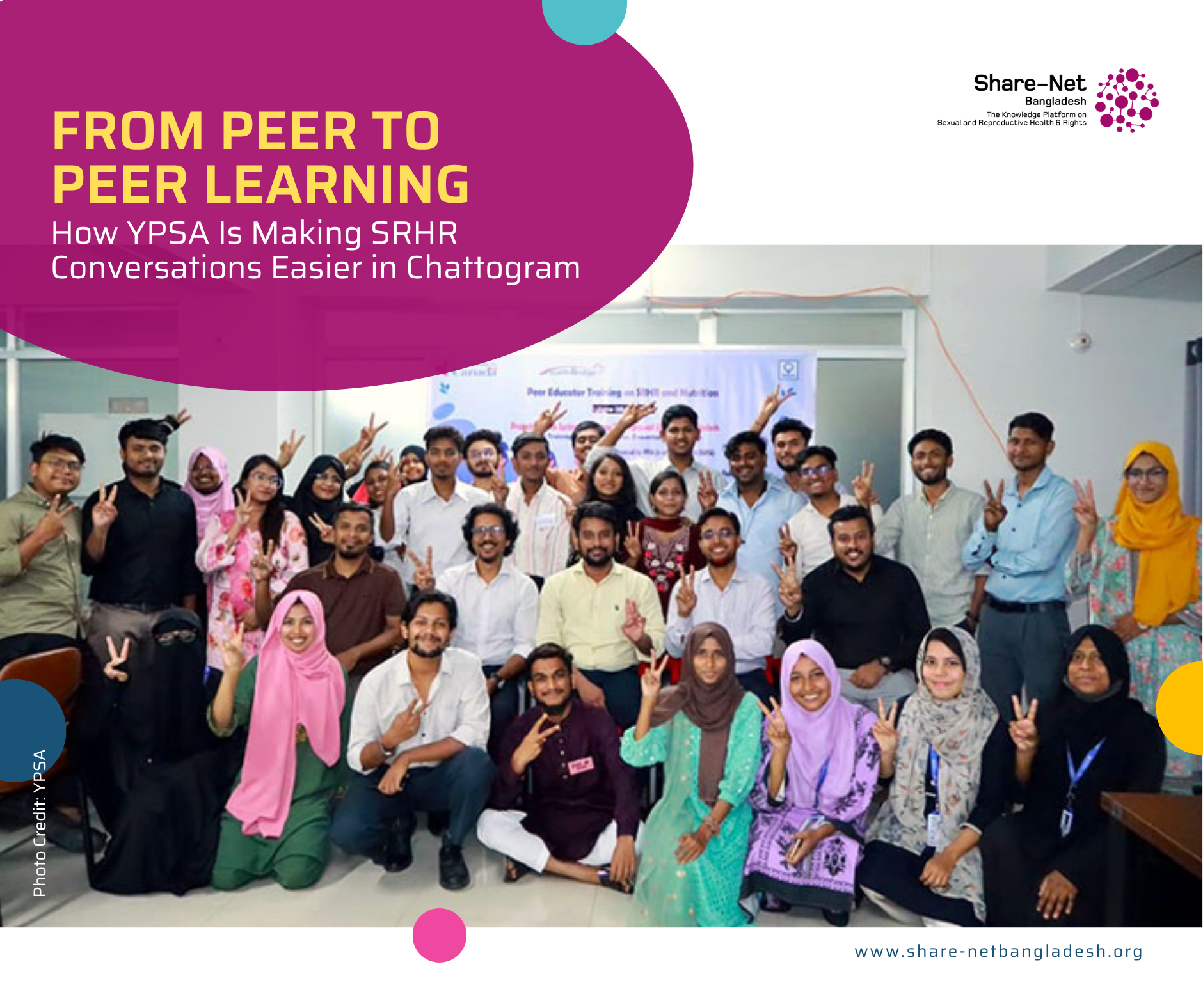
More recently, YPSA organised a three-day training in Chattogram in June 2026 to strengthen young people’s leadership on SRHR, gender equality, nutrition, safe motherhood and life skills. The trained educators were prepared to conduct sessions in communities and educational institutions and provide referral support to health services.
There is also evidence from Bangladesh that adolescents can become effective communicators themselves. UNICEF documented the experience of a young peer leader who began facilitating conversations on menstruation and puberty after receiving support through adolescent-friendly health services. The safe, peer-led space helped other girls ask questions they were uncomfortable raising elsewhere.
The strength of peer education, then, is not that young people replace doctors or trained health professionals. They do not. Its strength is that they can become a bridge between information and action.
For Bangladesh, that bridge deserves wider investment. Peer educators can complement formal CSE, adolescent-friendly health services, schools and community programmes. They can help make SRHR less clinical, less intimidating and more conversational.
If Bangladesh wants adolescents to ask questions, understand their rights and seek services when they need them, it may need to rethink not only what young people are taught, but also who gets to start the conversation.
Chattogram’s experience suggests that sometimes the most trusted SRHR educator may simply be someone sitting next to them.
Original Contributor:
Shyamashree Das
Program Manager, Young Power in Social Action (YPSA)
Coordinator, Youth Share-Net Project